BNPL Dispute Response Calculator
Dispute Analysis Tool
Enter your dispute details to get provider-specific guidance on evidence requirements, deadlines, and fees.
Dispute Analysis Results
When a customer buys something with BNPL and later claims they never got the item-or it’s broken-merchants don’t just get a return request. They get a tangled mess of rules, deadlines, and hidden fees that vary by provider. Unlike credit cards, where the process is standardized, each BNPL company-Affirm, Klarna, Afterpay, Sezzle-has its own playbook. And if you’re not following it exactly, you lose money.
Why BNPL Disputes Are Different from Credit Card Chargebacks
With a credit card, the bank handles the dispute. You submit proof, they decide, and if you lose, the money comes out of your account. Simple. With BNPL, the provider pays you upfront. The customer pays the provider in installments. So when a dispute happens, the provider becomes the middleman-and they’re not always fair. The Consumer Financial Protection Bureau (CFPB) stepped in in March 2023 and said BNPL providers must follow the same rules as credit card companies under Regulation Z. That means they must investigate disputes, pause payments during the process, and refund money if the item was returned or never delivered. Sounds good, right? But here’s the catch: the providers still get to decide how they handle it. Merchants are stuck in the middle. You can’t just tell the customer to talk to Affirm. You’re still responsible for proving delivery, handling returns, and dealing with the fallout when the provider sides with the customer-even if your evidence is solid.How BNPL Providers Handle Disputes (And Why It’s a Mess)
Every BNPL company has different rules. You can’t treat them the same way.- Affirm: Gives you 14 days to respond. Requires signed delivery confirmation. If you provide it, you win 68% of the time on "item not received" claims.
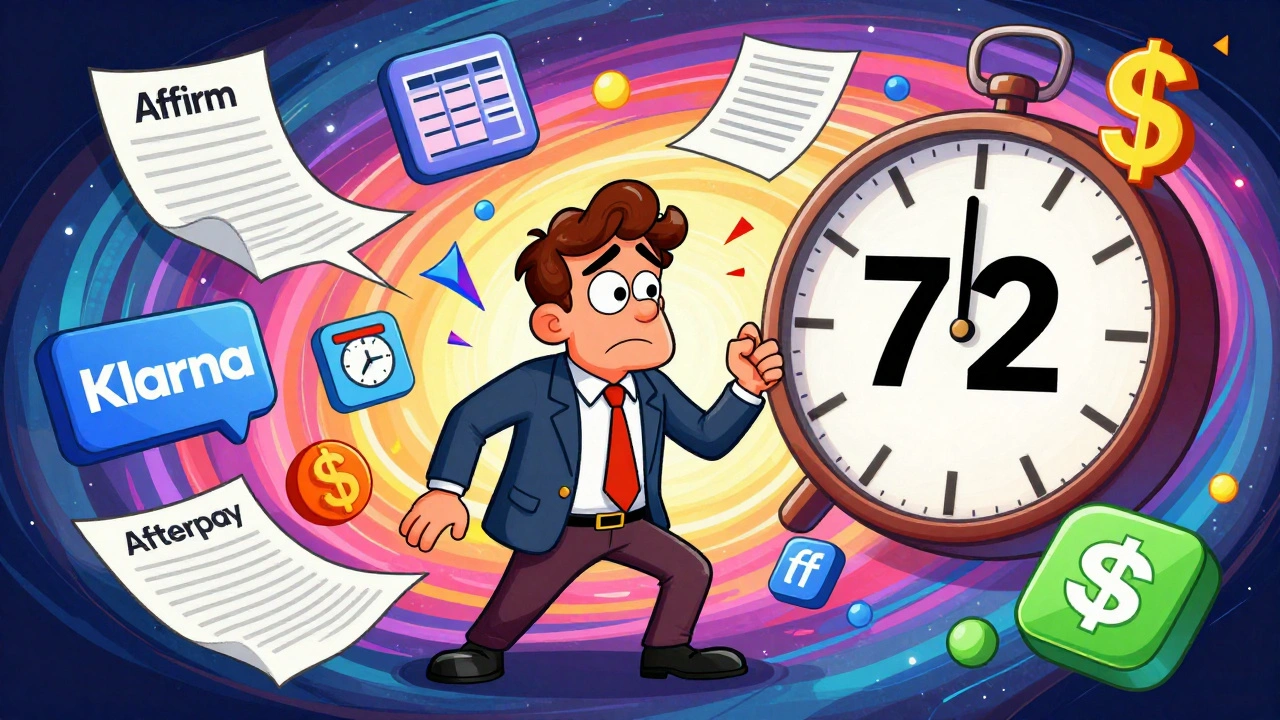
- Klarna: Only gives you 72 hours to respond. Demands proof of delivery within that window. If you miss it, you lose-even if you had the signature. Their merchant win rate for the same claim is just 42%.
- Afterpay: Automatically refunds transactions under $50 through Visa’s Rapid Dispute Resolution (RDR). No investigation. No appeal. Just money gone.
- Sezzle: For claims over $150, they require video proof of package delivery. Not a photo. Not a tracking screenshot. Actual video.
The Hidden Costs of BNPL Disputes
It’s not just about losing the sale. You pay fees, lose time, and risk your merchant account.- Affirm charges a $15 dispute fee per case, plus you have to repay the full amount if the dispute is upheld.
- Klarna doesn’t charge a fee, but they don’t give you much time to respond. Miss the deadline, and you’re on the hook.
- Afterpay’s auto-refund system for small claims means you lose $50 or less without a fight-even if the customer is lying.
What Evidence Actually Works?
Proof of delivery isn’t enough anymore. You need the right kind of proof for each provider.- For Affirm and Klarna: Signed delivery confirmation with the recipient’s name and date. FedEx, UPS, or USPS tracking alone won’t cut it.
- For Sezzle: Video footage of the package being handed to the customer. No exceptions.
- For Afterpay: If you’re using Visa’s RDR, you can set rules to auto-refund claims under $50. It’s cheaper than fighting.
- For all: Keep communication logs. If the customer emailed you saying "I didn’t get it," and then filed a dispute, that’s evidence you can submit.
How to Protect Your Business
You can’t control how BNPL providers operate. But you can control how you respond.- Set up auto-refunds for small claims. If you’re using Visa’s RDR, configure your system to auto-refund any "item not received" dispute under $50. It costs less than fighting.
- Use a unified dispute platform. Tools like Chargeflow and Chargeback Gurus let you manage all BNPL providers in one dashboard. 43% of enterprise merchants now use them.
- Track deadlines like a hawk. Klarna gives you 72 hours. Affirm gives you 14. Set calendar alerts. Don’t rely on email notifications-they’re unreliable.
- Document everything. Save delivery receipts, customer emails, return requests, and tracking numbers in a folder labeled "BNPL Disputes." You’ll need them.
- Know your contract. Read the fine print. Some providers hold you liable for 89% of "item not as described" claims. That’s higher than credit cards.
What’s Changing in 2025?
The industry is starting to wake up. In November 2023, the Electronic Transactions Association formed a BNPL Dispute Working Group to create common standards by Q3 2024. That’s a big deal. Klarna launched its Merchant Dispute Dashboard in September 2023, giving real-time tracking. Affirm extended their response window from 7 to 14 days. These are small wins. Gartner predicts 45% of merchants will use AI-powered dispute tools by 2025. These tools can automatically match your delivery proof to the provider’s requirements and flag risky claims before they turn into disputes. But here’s the reality: until there’s one standard, you’re still playing a game where the rules change every time you switch providers.What to Do When a Dispute Hits
When a dispute lands in your inbox:- Don’t panic. Don’t reply to the customer. They’re not the decision-maker.
- Check which BNPL provider it came from.
- Log into their merchant portal immediately.
- Find their exact evidence requirements.
- Upload what they need-within their deadline.
- Keep a copy of everything you submitted.
Final Reality Check
BNPL is convenient for customers. But for merchants? It’s a minefield. The CFPB’s 2023 rules helped-but they didn’t fix the system. They just made providers follow the letter of the law, not the spirit. If you’re using BNPL, you’re not just accepting payments. You’re accepting risk. And that risk is growing. The best merchants aren’t the ones who use BNPL the most. They’re the ones who understand the rules, plan for the disputes, and have systems in place before the first claim hits. You can’t avoid BNPL. But you can stop getting burned by it.Can I refuse to accept BNPL payments?
Yes, you can. BNPL is an optional payment method. If the disputes, fees, and administrative burden are too high for your business, you can remove it from your checkout. Many small merchants do. The trade-off is losing sales to customers who only shop with BNPL-but for some, the cost of handling disputes outweighs the benefit.
Do I have to refund a customer if they return an item bought with BNPL?
Yes, you do. But you don’t refund the customer directly. You refund the BNPL provider. The provider then adjusts the customer’s payment schedule. If the customer already paid off the item, the provider issues a refund to them. Your job is to process the return and notify the provider. Failure to do so can result in chargebacks and penalties.
Why does Afterpay automatically refund small claims?
Afterpay uses Visa’s Rapid Dispute Resolution (RDR) system, which allows merchants to set rules for automatic refunds on low-value claims. It’s designed to prevent small disputes from becoming formal chargebacks, which hurt the merchant’s dispute ratio. While it costs you money on false claims, it saves you time, fees, and potential account penalties from the payment network.
Can I get my money back if a BNPL provider sides with the customer unfairly?
It’s difficult, but not impossible. If you have clear evidence and believe the provider violated CFPB rules, you can file a complaint with the Consumer Financial Protection Bureau. They’ve taken enforcement action against Afterpay and Klarna in the past for poor dispute handling. While they won’t reverse a single decision, repeated complaints can pressure providers to change their policies.
Is BNPL worth it for my online store?
It depends. If you sell high-ticket items under $300 in fashion, electronics, or home goods, BNPL can boost sales. But if you sell digital products, subscriptions, or items that are hard to return, the dispute rate is higher and the risk is greater. Track your BNPL dispute rate compared to credit card transactions. If it’s over 15%, you’re losing more than you’re gaining.
What’s the most common mistake merchants make with BNPL disputes?
Waiting too long to respond. Many merchants treat BNPL disputes like regular returns. They don’t realize the provider has a 72-hour or 14-day deadline. Missing it means automatic loss-even if you had perfect proof. Set calendar alerts, assign someone to check BNPL portals daily, and don’t assume you’ll get an email reminder.



Comments
Broooooo 🤯 BNPL is literally the wild west out here. I just lost $12k last quarter because I didn’t know Sezzle wanted VIDEO proof. I thought a screenshot of the delivery app was enough. 😭 Now I’ve got a spreadsheet with 17 different rules for 5 providers. I’m not a lawyer, I’m a Shopify store owner who sells hoodies. 🙃
OMG you people are so naive. Of course they’re screwing you. These companies are predatory AF. They lure you in with ‘easy payments’ then trap you with secret clauses and 72-hour deadlines like some kind of digital loan shark. 😒 And don’t even get me started on how they let customers return ‘used’ items and still get refunded. I’ve seen people return a $200 pair of shoes that smell like gym socks and call it ‘not as described’. The system is BROKEN. 🤬
honestly i think the auto-refund for under $50 is kinda smart? like yeah it sucks when someone lies but fighting it costs more in time + stress than the money lost. i’ve been using chargeflow since last year and it’s been a game changer. still messy but at least i’m not crying over emails anymore 😅
It’s not merely a logistical issue-it’s a systemic failure of contractual asymmetry. The merchant bears the burden of proof, the provider bears none of the consequence, and the consumer bears no accountability. This is not capitalism; it’s algorithmic feudalism. The CFPB’s regulation is a bandage on a severed artery. The real question is: why do we continue to participate in a system where the rules are deliberately obfuscated, deadlines are arbitrary, and the power structure is inverted? We are not merchants-we are data points in a risk-assessment matrix. And until we recognize that, we will remain powerless.
you ever notice how all the big BNPL companies are owned by the same few investors? and how they all have the same weirdly similar dispute policies? and how they all magically update their terms right after congress talks about regulating them? hmmmm… i think this is all coordinated. they’re testing how much they can screw small businesses before the public wakes up. i’ve got a spreadsheet of 87 cases where the same customer filed disputes across 3 different platforms. same address. same card. same email. but none of the providers talk to each other. someone’s getting rich off this chaos… and it ain’t us.