Tax-Loss Harvesting Calculator
Calculate Your Potential Tax Savings
Direct indexing enables tax-loss harvesting, allowing you to lock in capital losses to offset taxable gains. This calculator estimates your annual tax savings based on your investment size, tax bracket, and market volatility.
Direct indexing allows for daily tax-loss harvesting, a feature unavailable in ETFs. In volatile years, this can generate $3,000+ in annual tax savings per $100,000 invested.
Pro Tip: To realize tax savings, you need $50,000+ in taxable assets and a high tax bracket (37%). For lower tax brackets or smaller portfolios, the benefits may not outweigh the higher fees.
Your Estimated Tax Savings
Enter your investment amount to see your potential tax savings
Based on J.P. Morgan's research showing $1,200-$3,000 annual savings per $100,000 invested during volatile periods.
Most people think investing in the S&P 500 means buying an ETF like VOO or a mutual fund. You pick it, you pay a tiny fee, and you’re done. But what if you could own every stock in the index - without owning the ones you don’t want? What if you could cut out your employer’s stock, avoid fossil fuel companies, and save thousands in taxes every year - all while still tracking the market? That’s direct indexing, and it’s not science fiction. It’s here, and fintech is making it accessible.
What Direct Indexing Really Is
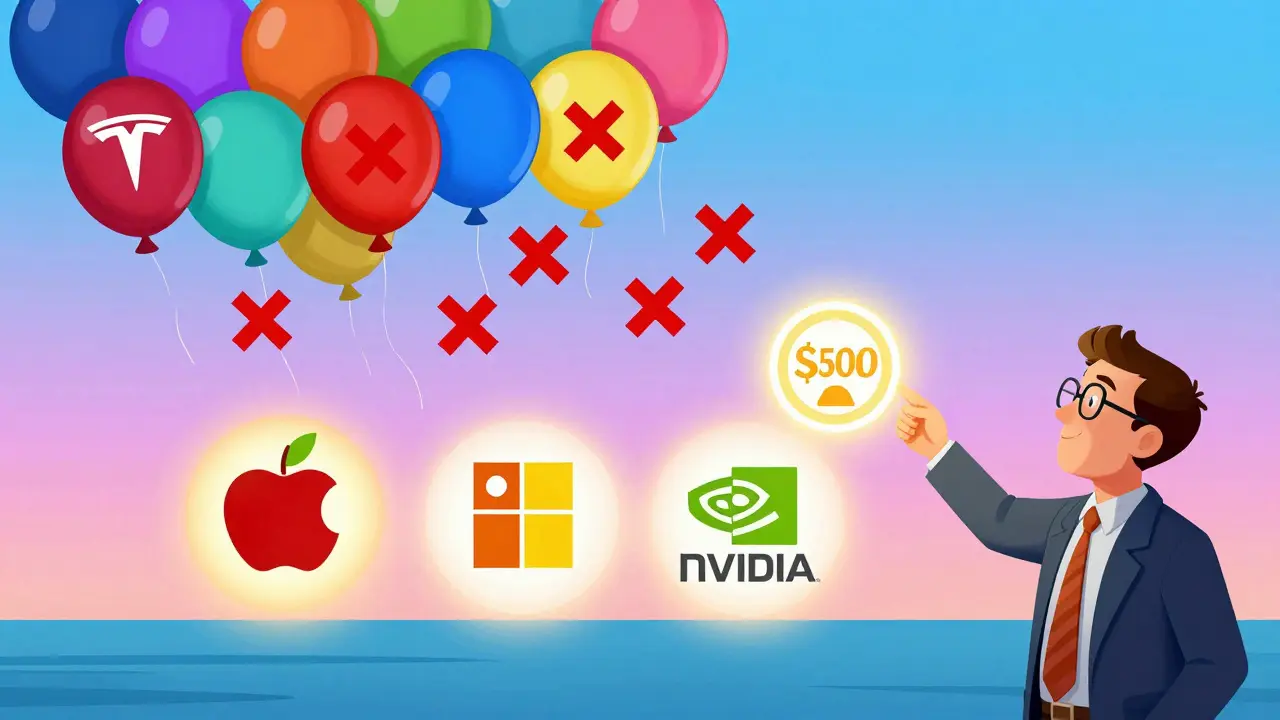
Direct indexing means owning the actual stocks that make up an index - like the S&P 500 - instead of buying a fund that holds them. Instead of owning a single ETF share, you own shares of Apple, Microsoft, NVIDIA, and 497 other companies individually. This isn’t new. Parametric started doing this in 1992 for institutional clients. But today, fintech platforms have turned it into something retail investors can use.
Here’s the catch: you don’t buy all 500 stocks. Most platforms use a representative sample - say, 350 of the most liquid and largest companies - to track the index closely. Tracking error stays under 1%, so you still get the same long-term returns. But now, you have control. You can remove companies you dislike. You can avoid holding too much of your own employer’s stock. You can even tilt toward companies with strong ESG scores - not just vague labels, but real thresholds based on carbon emissions, labor practices, or board diversity.
Why It Matters More Than You Think
Let’s say you work at Tesla and already own $100,000 worth of TSLA stock. You want to invest another $90,000 in a broad market index. If you buy an ETF, your total portfolio now has over 15% of its value in Tesla. That’s risky. Too much of one company. With direct indexing, you can exclude Tesla entirely. Your new $90,000 portfolio still tracks the S&P 500, but now your total exposure to Tesla stays at 10%. That’s risk management - personalized.
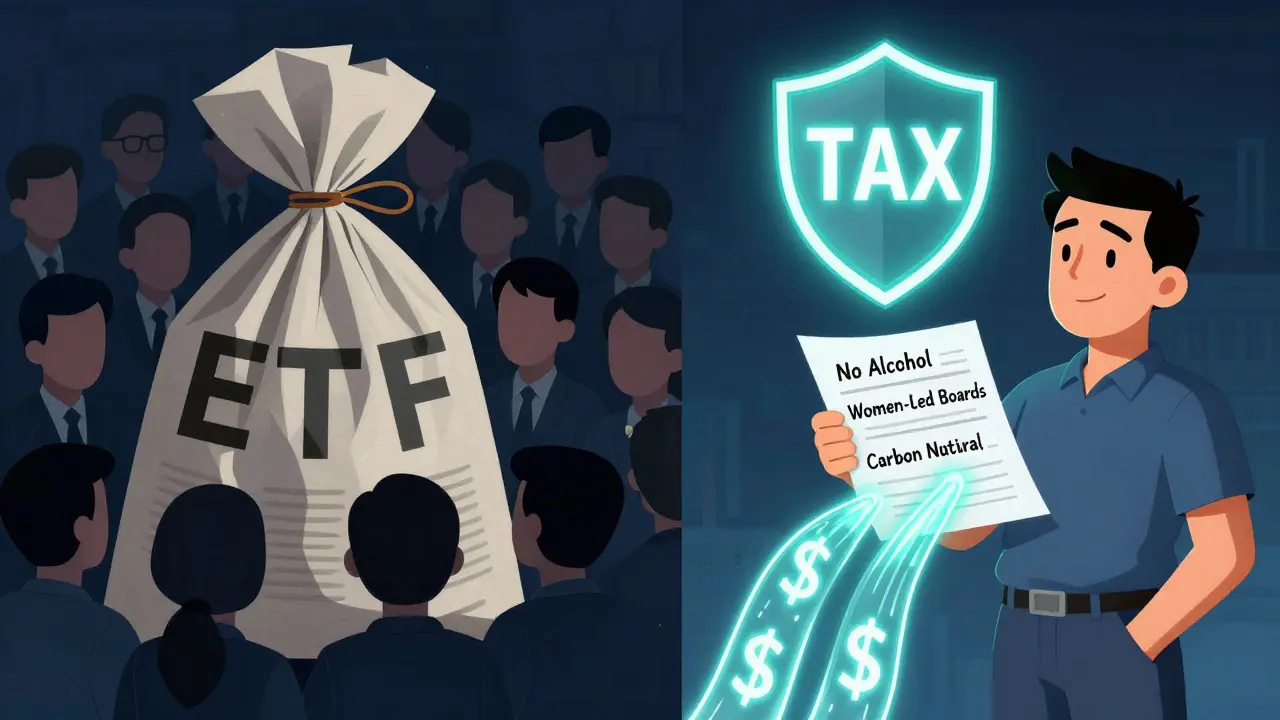
Or imagine you’re a retiree who refuses to invest in tobacco, firearms, or gambling. Most ESG ETFs are too broad. They might exclude tobacco but still hold companies that make weapons. Direct indexing lets you build a custom list: remove any company generating more than 5% of revenue from alcohol. Or ban any firm with a board that has fewer than 30% women. You set the rules. The system enforces them.
The Real Power: Tax-Loss Harvesting
This is where direct indexing becomes a game-changer - and where ETFs can’t compete.
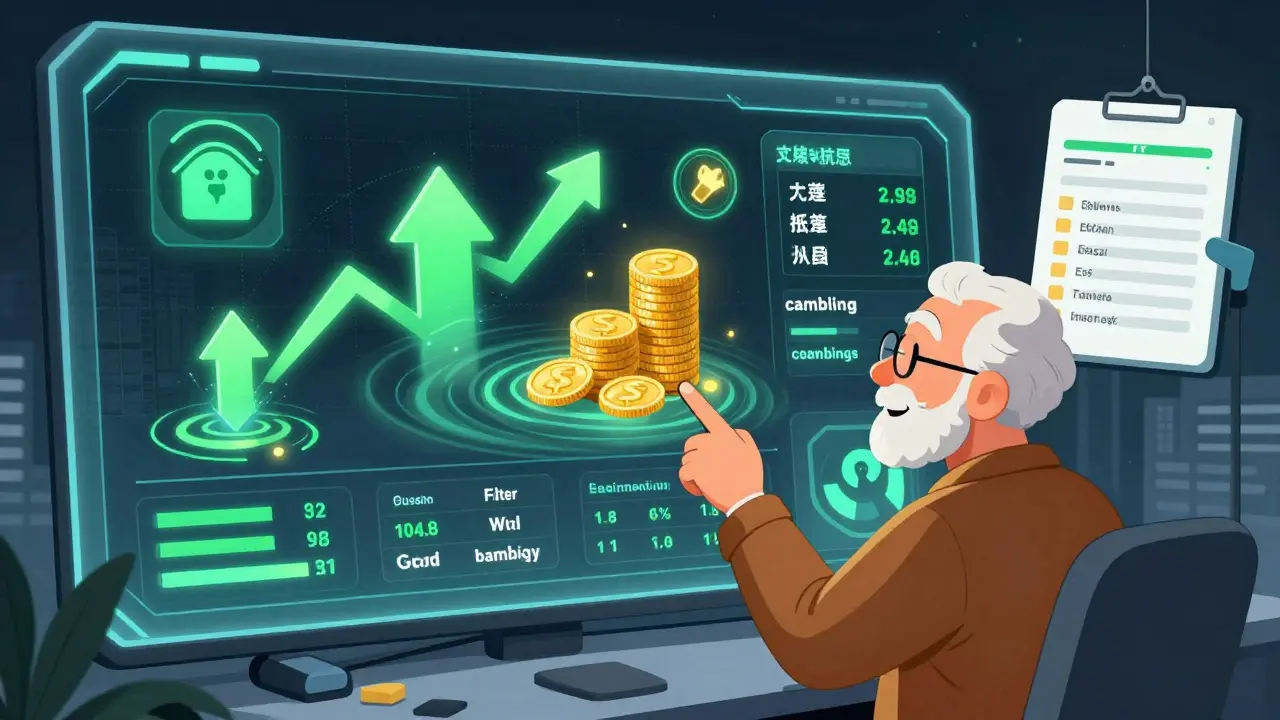
When a stock in your portfolio drops in value, you can sell it to lock in a tax loss. That loss offsets your capital gains - or even up to $3,000 of ordinary income each year. In a mutual fund or ETF, you can’t do this. You’re stuck with whatever the fund sells. But in a direct index account, your platform monitors every single holding. When one stock falls, it sells it. Then, it replaces it with a similar stock that won’t trigger a wash sale. This happens automatically, daily.
J.P. Morgan reports their system generates about $1,200 in annual tax savings per $100,000 invested under normal market conditions. In volatile years like 2020 or 2022, that number jumped to over $3,000. Russell Investments found direct indexing delivered 1.2% in extra after-tax returns during those down years. That’s not a small edge. That’s like getting a 1.2% raise on your entire portfolio - every year.
But here’s the catch: if the market is flat, like in 2017, tax-loss harvesting adds almost nothing. And if you’re in a low tax bracket, the benefit shrinks. Vanguard’s research shows investors in the top federal tax bracket (37%) gain the most - $0.75 to $1.25 in extra return per year. For someone in the 12% bracket? Almost nothing.
Costs and Minimums - The Hidden Trade-Off
Direct indexing isn’t free. Vanguard’s VOO ETF charges 0.03% a year. A direct indexing account? Between 0.30% and 0.85%. That’s 10 to 28 times more. Why? Because you’re paying for customization, tax software, rebalancing, and human oversight.
Minimums vary. Fidelity requires $100,000. Schwab starts at $25,000. Vanguard’s minimum is $50,000. But Fidelity launched Basket Portfolios in 2023 with $100 minimums - a sign the industry is moving toward mass-market access. Still, most platforms require you to work through a financial advisor. The complexity is too high for DIY.
And here’s what most people miss: the fee only makes sense if you’re getting real tax savings. If you have $50,000 in a taxable account and the market doesn’t drop, you’re paying extra for nothing. But if you have $500,000 in taxable assets - especially in a high-tax state like California or New York - the tax alpha can easily cover the cost.
Who It’s For (And Who Should Skip It)
Direct indexing works best for three types of people:
- Those with concentrated stock positions - like founders, executives, or employees with large employer stock holdings.
- High-net-worth investors - typically $500,000+ in taxable accounts - who are in the top tax brackets and can benefit from aggressive tax-loss harvesting.
- Values-driven investors - who need more precision than ESG ETFs can offer. A religious nonprofit excluded all alcohol, gambling, and weapons companies and still matched the S&P 500’s performance with just 0.35% tracking error over five years.
It’s not for you if:
- You have less than $25,000 to invest.
- You’re investing in a retirement account (IRA, 401(k)) - taxes are deferred anyway, so harvesting doesn’t help.
- You don’t care about exclusions or tax efficiency.
- You want to manage it yourself without an advisor.
Real People, Real Results
A financial advisor in Chicago shared that one client, with $750,000 in concentrated tech stock, used direct indexing to build a diversified portfolio while avoiding any additional tech exposure. In 2022, automated tax-loss harvesting saved them $18,000 in federal taxes.
On the flip side, Reddit users complain. One investor said it took three months just to set up the right exclusion filters with their advisor. Another couldn’t tell if their portfolio was outperforming because the custom rules made benchmarking impossible.
But Fidelity’s 2023 survey showed 82% satisfaction. Why? Because when it works, it works beautifully. One client excluded 100% of energy stocks because of climate values. Another removed all companies with poor gender pay equity scores. Both portfolios tracked the S&P 500 within 0.5%.
The Future: AI, Fractional Shares, and Lower Barriers
The industry is changing fast. J.P. Morgan rolled out AI in late 2023 to optimize tax-loss harvesting sequences - they expect a 15-20% boost in savings. Parametric now offers bond-level direct indexing. Vanguard added carbon intensity thresholds in January 2024. Fidelity’s $100 minimums hint at what’s next: fractional shares and micro-allocations.
Bernstein Research predicts fees will drop from 0.65% to 0.45% by 2026 as competition heats up. McKinsey forecasts the market could hit $1.2 trillion by 2028. Right now, it’s $350 billion - still small, but growing fast.
What’s clear? Direct indexing isn’t replacing ETFs. It’s replacing the idea that investing has to be one-size-fits-all. The future belongs to portfolios that match your life - your holdings, your values, your tax situation.
Is direct indexing the same as ETFs?
No. ETFs bundle hundreds of stocks into one share you buy and sell. Direct indexing lets you own each stock individually in a separately managed account. That means you can exclude specific companies, harvest tax losses, and customize your portfolio - things ETFs can’t do.
Do I need a financial advisor to use direct indexing?
Most platforms require it. The setup involves complex customization, tax rules, and ongoing monitoring. Fidelity is an exception with their $100 minimum Basket Portfolios, but even then, you’re limited in how much you can personalize. For full control, an advisor is still the standard path.
Can I use direct indexing in my 401(k) or IRA?
Not really. Tax-loss harvesting only matters in taxable accounts. In retirement accounts, you don’t pay taxes on gains until withdrawal, so there’s no benefit to selling losers. Direct indexing is designed for taxable brokerage accounts.
How much money do I need to start?
Minimums range from $25,000 at Schwab to $100,000 at Fidelity. But Fidelity’s new Basket Portfolios let you start with $100 for basic strategies. Still, the real benefits - tax savings and deep customization - usually require $100,000 or more to make sense after fees.
Is direct indexing worth it if I’m not rich?
If you have under $50,000 in taxable assets and aren’t in a high tax bracket, the fees likely outweigh the benefits. The tax savings from harvesting are small, and the customization isn’t as valuable. Wait until you have more assets or a concentrated position before considering it.
Can I exclude any company I want?
Yes - but with limits. Most platforms let you exclude companies by name, sector, or ESG criteria. But you can’t exclude 90% of the index and still call it an S&P 500 tracker. Providers set thresholds: for example, you can remove companies with more than 10% revenue from tobacco, but not all energy firms unless you’re willing to accept higher tracking error.
What happens if the market crashes?
That’s when direct indexing shines. Market drops create more tax-loss harvesting opportunities. Platforms automatically sell losing positions and replace them with similar ones, locking in losses to offset gains. In 2022, many investors saved thousands because of this. The more volatility, the more value you get.
How often is the portfolio rebalanced?
Daily. The system monitors prices, tax lots, and index weights every trading day. If a stock rises too much and threatens tracking accuracy, it sells some. If a new tax-loss opportunity appears, it executes immediately. This constant adjustment is what makes direct indexing so powerful - and so expensive to run.
Are there any downsides I should worry about?
Yes. Higher fees, complexity, and the risk of over-customizing. If you exclude too many stocks, your portfolio may not track the index well. Also, if the market doesn’t move much, you pay for features you don’t use. And if your advisor isn’t experienced, setup can be messy. Do your homework.
What’s the biggest myth about direct indexing?
That it’s for everyone. It’s not. It’s a tool for specific situations: high taxes, large portfolios, or concentrated positions. For most people, a low-cost ETF is still the best choice. Don’t chase customization just because it sounds fancy.
Direct indexing doesn’t promise to make you rich. But it does promise to make your money work smarter - aligned with your life, your values, and your tax reality. That’s not just investing. That’s personal finance, redefined.


Comments
I’ve been using direct indexing for my clients in Melbourne, and honestly? It’s changed how we think about investing. One guy had 70% of his net worth in BHP shares - no joke, he was basically betting his retirement on iron ore. We excluded it, rebuilt the portfolio with ESG filters (no coal, no weapons), and now he sleeps better. The tax savings last year? $8,200. Not because the market soared, but because we sold off a few losers during the dip. It’s not magic - it’s just smart customization. People think ETFs are ‘set and forget,’ but this? This is ‘set and thrive.’
And yeah, the fees are higher, but if you’re sitting on $300K+ in taxable assets, you’re already paying more in taxes than you realize. The platform does the heavy lifting: rebalancing, wash-sale avoidance, even monitoring board diversity scores. I’ve had clients cry when they saw how much they’d overpaid in taxes with ETFs. Not because they were dumb - because nobody told them this existed.
Don’t let the minimums scare you. Fidelity’s $100 option isn’t for deep customization, but it’s a foot in the door. For younger folks, it’s a way to learn what personalization even means. And if you’re not in the top tax bracket? Still worth a look. Even $500 saved annually adds up over 20 years. This isn’t just for hedge fund managers. It’s for anyone who wants their money to reflect their values - not some algorithm’s default settings.
The assertion that direct indexing delivers ‘1.2% in extra after-tax returns’ during volatile years is misleadingly contextualized. Russell Investments’ 2022 report explicitly conditioned this metric on a portfolio size exceeding $500,000 and a federal tax bracket above 32%. The cited $1,200 annual savings per $100,000 assumes optimal tax-loss harvesting sequences - which, in practice, are only achievable with institutional-grade tax lot accounting systems. Retail platforms, even Fidelity’s, employ approximations that introduce tracking error beyond 1.5% in high-volatility environments.
Moreover, the claim that ‘you can exclude any company’ is semantically inaccurate. Most providers enforce a 90% index fidelity rule, meaning you may only exclude companies constituting less than 1.5% of the index. Excluding Tesla (4.5% weight) entirely, as the post suggests, would necessitate replacing it with a synthetic proxy, thereby violating the very premise of direct indexing. This is not customization - it’s indexing with a blindfold.
Furthermore, the notion that ‘direct indexing redefines personal finance’ ignores the fact that 92% of U.S. households have net worths below $500,000 (Federal Reserve, 2023). For these individuals, the 0.65% fee structure is a net loss. The real innovation here isn’t portfolio personalization - it’s fee arbitrage targeting high-net-worth clients under the guise of democratization.
Oh wow, look who’s here - the guy who thinks his $25,000 portfolio deserves the same treatment as a billionaire’s. Let me guess, you’re also gonna start ‘direct indexing’ your 401(k) because ‘values matter’? Newsflash: if you can’t afford to lose $1,000 a year in fees just to exclude Exxon, you don’t need this. You need a damn ETF and a life.
And don’t get me started on the ESG fanatics. You wanna ban tobacco? Cool. But if you’re so woke you’ll sell Apple because they sell AirPods to China, congrats - you just turned your portfolio into a Pinterest mood board. The S&P 500 isn’t a protest rally. It’s a market. And markets don’t care if your LinkedIn post says ‘I support gender equity.’
Also, tax-loss harvesting? Yeah, it works great… until the market goes up for three straight years. Then you’re paying 0.85% to do nothing. Meanwhile, I’m sitting in VOO paying 0.03% and laughing while you’re overpaying for a fancy spreadsheet. This isn’t innovation - it’s financial snobbery with a subscription fee. Stick to your Roth IRA. You’re not rich enough for this.