Dividend Growth vs Current Yield Calculator
Investment Strategy Comparison
Compare the long-term income potential of dividend growth strategies versus high current yield strategies. Enter your initial investment and strategy preferences to see which approach builds more income over time.
Comparison Results
Your investment of $10,000 will generate more income with dividend growth after 7-10 years. This reflects the power of compound growth in dividend investing strategies.
| Year | High Yield Income |
Dividend Growth Income |
Growth Advantage |
|---|
Key Insights
The dividend growth strategy will eventually outperform the high current yield strategy, especially as the investment period extends. This demonstrates the power of compounding dividends over time.
What This Means For You
If you're investing for the long term (10+ years), dividend growth strategies build more income over time. But if you need income immediately, high current yield strategies provide more cash flow upfront.
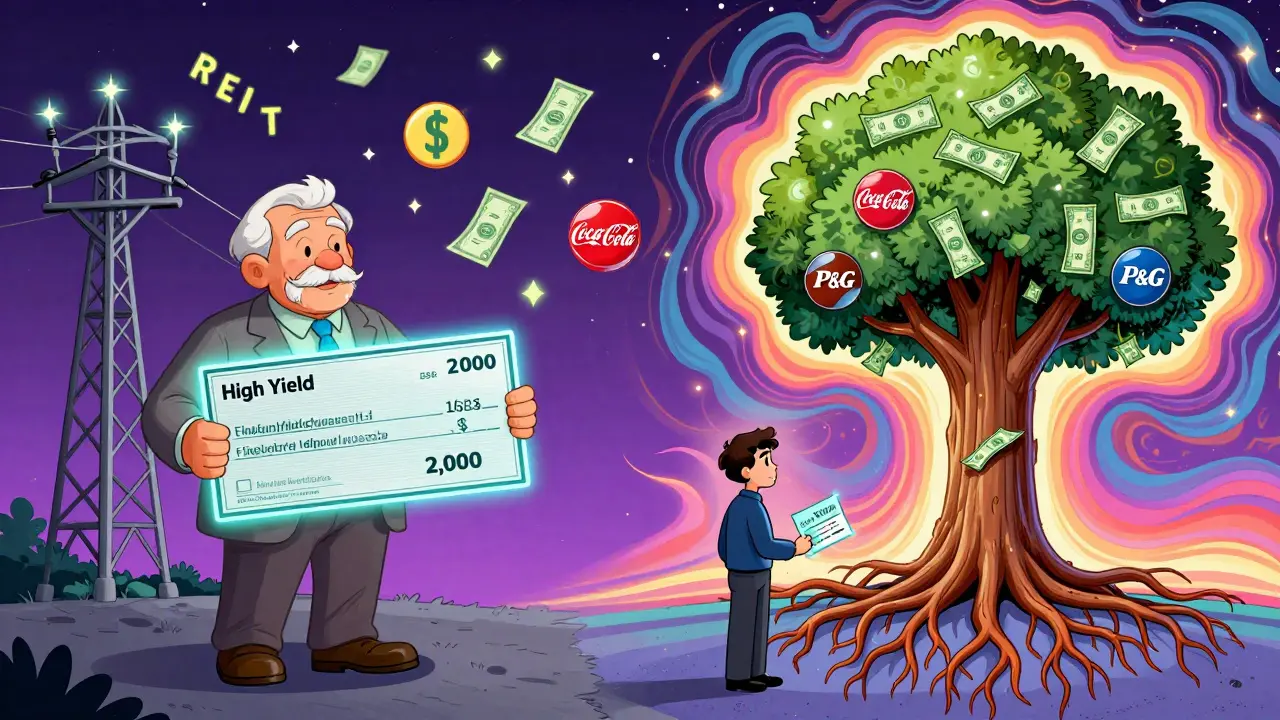
When you're building income from stocks, two paths keep showing up: one chasing high payouts today, the other betting on steady increases tomorrow. It’s not about which is better-it’s about which fits your life. If you need cash now to pay bills, a high current yield might feel like a lifeline. If you’re thinking 10, 15, or 20 years ahead, dividend growth could quietly turn a small check into a major income stream.
What Is Dividend Growth Investing?
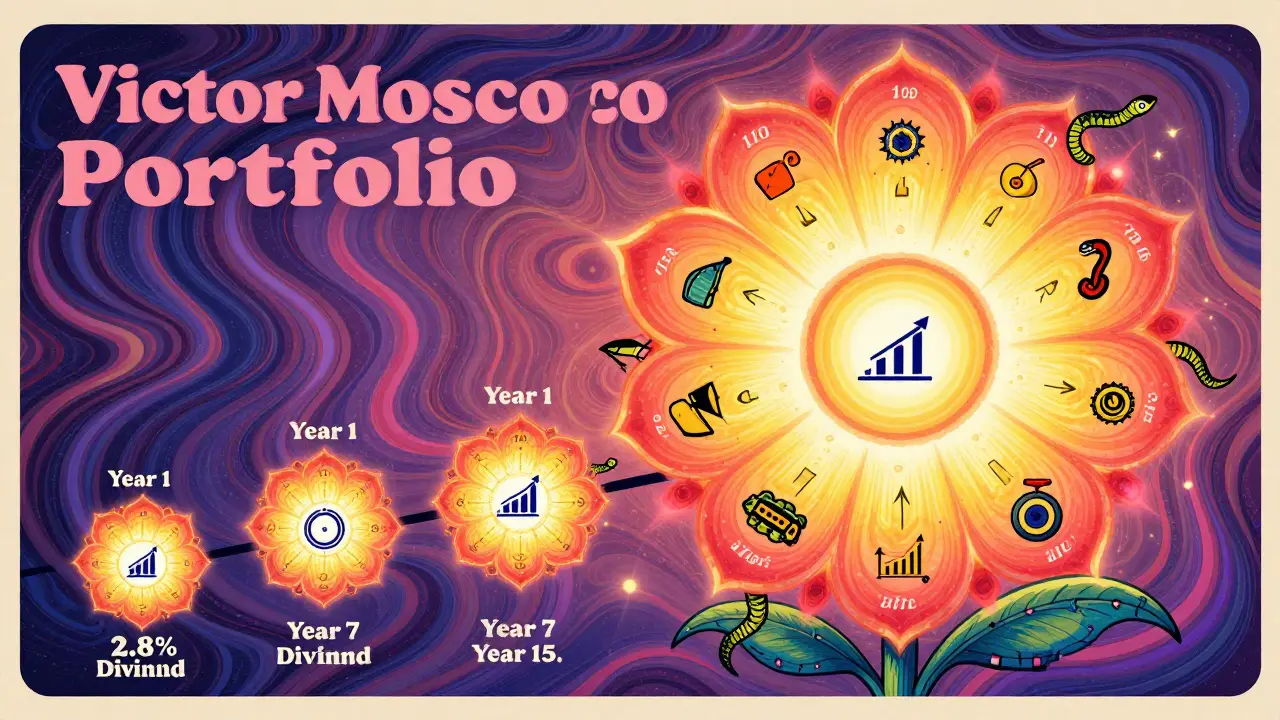
Dividend growth investing means buying stocks from companies that have a history of raising their dividends every year-often for decades. These aren’t flashy tech startups. They’re the steady, reliable names: Coca-Cola, Johnson & Johnson, Procter & Gamble, and others in the S&P 500 Dividend Aristocrats list. To make that list, a company must have increased its dividend for at least 25 straight years. That’s not luck. It’s discipline.These companies don’t pay the highest yields upfront. The average yield for dividend growth stocks is around 2.4%. That might seem low compared to other options. But here’s the trick: they grow. On average, they raise dividends by 8% to 12% a year. Over time, that compounds. If you bought a stock yielding 2% and it raised its payout by 10% annually, after seven years, your yield on cost-the dividend relative to what you paid-would be over 4%. After 15 years? Close to 8%. That’s not speculation. That’s math.
What makes these companies able to keep raising dividends? They have strong balance sheets. Look at their return on equity (ROE). Healthy dividend growers usually have ROE above 15%. Their payout ratios-how much of their earnings they pay out as dividends-are typically under 60%. That leaves room to reinvest in the business, weather downturns, and still keep raising payouts. Companies like these don’t just pay dividends-they build moats around their businesses.
What Is High Current Yield Investing?
High current yield investing is simpler in concept: find stocks that pay the biggest dividends right now. You’re looking for yields of 3% to 5% or even higher. Popular choices include utilities, real estate investment trusts (REITs), and energy companies. ETFs like Vanguard High Dividend Yield (VYM) or iShares Select Dividend (DVY) track these kinds of stocks.The appeal is obvious: more cash in your pocket today. If you’re retired and need $2,000 a month from your portfolio, a 4.5% yield means you need $533,000 invested. A 2.5% yield? You’d need nearly $960,000. For people living on fixed income, that difference matters.
But there’s a catch. High yields often come with risk. Companies that pay out 70%, 80%, or even 90% of their earnings as dividends don’t have much room to maneuver. If profits dip-because of rising costs, falling demand, or a recession-they might cut the dividend. That’s exactly what happened in 2020. Many high-yield REITs and energy firms slashed payouts during the pandemic. Investors who relied on that income got hit hard.
High yield stocks also tend to be more sensitive to interest rates. When Treasury yields rise, investors often flee from dividend stocks that look expensive relative to bonds. That’s why utilities and REITs often drop when the Fed hikes rates. Dividend growth stocks, with their lower starting yields, don’t get hit as hard. They’re less about the yield and more about the growth.
Performance Comparison Over Time
From 2005 through the end of 2024, the S&P 500 Dividend Aristocrats Index-made up of companies with 25+ years of dividend growth-outperformed the Dow Jones U.S. Select Dividend Index, which focuses on high yield. That’s not a fluke. It’s a pattern.Here’s why: dividend growth stocks don’t just pay you. They grow. S&P Global ran a simple simulation: two stocks. One starts at a 5% yield with no growth. The other starts at 3% but grows dividends by 10% a year. After 15 years, the growing stock pays out 10 percentage points more in dividend yield than the static one. That’s not a small edge. That’s life-changing for someone reinvesting dividends over decades.
During the 2022-2023 rate hike cycle, dividend growth ETFs like SCHD (Schwab US Dividend Equity ETF) held up better than high-yield ETFs. Why? Because investors weren’t fleeing them for bonds. Their yields were low enough that they didn’t look expensive compared to Treasuries. Meanwhile, high-yield REITs and utilities saw sharp drops as bond yields climbed.
And in the 2020 market crash? High-yield ETFs like VYM paid out big dividends at first-but many companies had to cut them later. VYM’s dividend dropped by over 15% in 2020. SCHD, on the other hand, kept growing. It didn’t miss a single increase. That’s the difference between a paycheck and a pension.

Who Should Choose Which Strategy?
If you’re 65 and retired, and your monthly bills are $4,000, you probably need the higher yield today. You can’t wait 10 years for dividends to grow. For you, VYM or a similar high-yield ETF makes sense-but only if you screen for financial strength. Look at free cash flow coverage. If a company pays out more than it earns, it’s a ticking time bomb.If you’re 35, 40, or even 50, and you’re building for the long haul, dividend growth is the smarter play. You don’t need the cash now. You need it to grow. SCHD, with its 2.8% yield and consistent 10%+ dividend growth, has turned into a favorite among FIRE (Financial Independence, Retire Early) communities. One Reddit user calculated that with SCHD’s growth rate, his yield on cost hit 5.5% in just seven years. That’s not magic. That’s compounding.
And here’s something most people miss: even retirees are shifting toward dividend growth. A 2024 analysis of retiree portfolios found that 62% of those with sustainable, inflation-protected income used dividend growth ETFs-not high-yield ones. Why? Because inflation eats away at fixed income. A 4% yield today might be worth only 2.5% in real terms after 10 years of 3% inflation. A growing dividend keeps up.
The Real Risk: Dividend Cuts and Inflation
The biggest mistake investors make is treating dividends like guaranteed income. They’re not. A dividend is a decision by a company’s board. It can be cut, frozen, or eliminated. That’s why you can’t just pick the highest yield and call it a day.Dividend growth investors avoid this by focusing on quality: consistent earnings, low debt, strong cash flow, and payout ratios under 60%. They look for companies that have raised dividends through recessions, oil crashes, and pandemics. That’s the real test.
High yield investors must be even more careful. They need to dig into the balance sheet. Is the company generating enough free cash flow to cover its dividend? Is it relying on debt to pay shareholders? Are earnings falling? A yield of 6% looks great-until the dividend gets cut in half.
And don’t forget inflation. A 4% yield today feels safe. But if inflation runs at 3% for the next decade, your purchasing power is down 26%. Dividend growth is the only hedge against that. A stock that raises its dividend 8% a year will double your income in less than a decade-even if prices rise.
ETFs to Watch
For dividend growth, SCHD (Schwab US Dividend Equity ETF) is the leader. It holds 90 high-quality U.S. stocks with 10+ years of dividend growth. It has a 2.8% yield, a 10-year average dividend growth rate of 10.2%, and $48.2 billion in assets. Its 4.3/5 Trustpilot rating comes from investors who’ve held it for five, seven, even ten years.For high yield, VYM (Vanguard High Dividend Yield ETF) is the biggest. It holds over 400 stocks with yields averaging 3.2%. But its dividend was cut in 2020, and its average payout ratio is 72%. It’s a good tool for income-but not a long-term wealth builder.
There’s also NOBL (S&P 500 Dividend Aristocrats ETF), which tracks only companies with 25+ years of dividend growth. It’s smaller, at $12.7 billion, but it’s pure dividend growth. No compromises.
Final Decision: It’s About Your Timeline
There’s no single right answer. But there’s a right answer for you.If you’re retired, need income now, and can tolerate some risk, high yield can work-but only if you avoid companies with shaky finances. Don’t chase yield blindly. Check the payout ratio. Look at free cash flow. Avoid REITs and energy companies that rely on volatile commodity prices.
If you’re still working, saving, or planning for retirement in 10+ years, dividend growth is the quiet powerhouse. It doesn’t shout. It doesn’t pay the biggest check today. But it builds real wealth over time. It protects you from inflation. It grows with you. And when you finally retire, your dividend income won’t just cover your bills-it might double them.
Dividend growth isn’t about getting rich quick. It’s about getting rich steadily. And in investing, that’s the kind of edge that lasts.
Is dividend growth investing better than high yield?
It depends on your goals. If you need cash today, high yield gives you more income right away. But if you’re investing for the long term, dividend growth wins. Companies that raise dividends consistently grow their stock prices too, and their payouts compound over time. After 10-15 years, a 2.5% yield growing at 10% annually can outpace a 5% yield that never changes.
Can you combine both strategies?
Yes, and many investors do. A common approach is to use dividend growth ETFs like SCHD as your core holding-60-80% of your dividend portfolio-and add a smaller portion of high-yield stocks or ETFs like VYM for extra current income. This balances growth with immediate cash flow, especially useful for retirees who need both.
What’s the safest dividend stock?
There’s no such thing as a completely safe dividend stock, but the safest are companies with 25+ years of dividend growth, low payout ratios (under 60%), strong balance sheets, and consistent earnings. Think Johnson & Johnson, Coca-Cola, or Procter & Gamble. These companies have raised dividends through every recession since the 1950s.
Do dividend growth stocks perform better in rising interest rates?
Yes, they tend to hold up better than high-yield stocks. When interest rates rise, investors often sell high-yield stocks like REITs and utilities because bonds look more attractive. Dividend growth stocks usually have lower starting yields, so they’re less sensitive to rate hikes. Their business quality and earnings growth also make them more resilient.
How long does it take for dividend growth to pay off?
It usually takes 7-10 years for dividend growth to really shine. That’s when your yield on cost-your dividend income divided by your original purchase price-starts to climb significantly. A 2% yield growing at 10% per year reaches 5% after seven years. That’s when the strategy becomes powerful. Patience is the key.
Are dividends better than stock buybacks?
It depends. Dividends give you cash you can spend or reinvest. Buybacks reduce the number of shares, which can boost earnings per share and stock price-but you don’t get cash unless you sell. Dividends are more predictable and taxable when received. Buybacks are more flexible for companies and can be more tax-efficient. Both return capital to shareholders. The best companies do both.



Comments
Yo, dividend growth is the real MVP 🚀 I bought SCHD in 2020 at $78… now it’s paying me 2x what I got back then. My yield on cost is 6.1% and I didn’t even do anything. Just sat there like a potato watching my money grow. Who needs crypto when your stocks are raising rent every year? 💸📈
LMAO you guys are acting like dividend growth is some holy grail. I’ve seen too many ‘stable’ companies cut dividends when times got rough. J&J? P&G? They’re not magic. They’re just big. And guess what? Big companies get lazy. They stop innovating. I got 5.8% from a REIT last year. Yeah, it got cut in 2020-but I moved on. You’re not building wealth, you’re just waiting for a miracle. Stop romanticizing slow. Go for the juice while you can.
honestly i think both have their place 😊 i started with vym because i needed cash for rent, but now i’m slowly shifting into schd. my yield on cost just hit 4.7% after 8 years. it’s not flashy, but it’s quiet and reliable. also, i’m not gonna lie-i kinda love that my dividend checks keep getting bigger without me doing a thing. like, my grandma would’ve called it ‘blessings in the mail’ 💌
Dividend growth is just a fancy way of saying ‘I’m too lazy to research real opportunities.’ You think a 2.8% yield is good? I’ve got a buddy who’s making 12% with private REITs and zero volatility. You’re not investing-you’re collecting pocket change while the real money moves. Also, SCHD? It’s just an ETF that owns the same 90 boring stocks everyone else owns. Where’s the edge? There isn’t one. Just stop pretending patience is a strategy.