QCD Tax Savings Calculator
Your Estimated Savings
How This Works
Your QCD reduces your taxable income without requiring itemized deductions.
If you're 70½ or older and have money in an IRA, you might be surprised to learn you can give directly to charity - and save on taxes at the same time. This isn’t a deduction. It’s not even a gift you report. It’s a Qualified Charitable Distribution, or QCD. And if you’re taking Required Minimum Distributions (RMDs), it could be one of the smartest moves you make this year.
What Exactly Is a QCD?
A Qualified Charitable Distribution lets you send money straight from your IRA to a qualified charity. The IRS lets you do this without paying income tax on the amount transferred. It’s not a deduction. It’s an exclusion. That means the money never shows up as taxable income on your return. And because it doesn’t increase your Adjusted Gross Income (AGI), it can lower your Medicare premiums, reduce how much of your Social Security is taxed, and even help you avoid the 3.8% Net Investment Income Tax. The rules are simple but strict: You must be 70½ or older. The money must go directly from your IRA custodian to the charity. You can’t receive the check first, then donate it. And you can only use funds from Traditional IRAs, Roth IRAs (only the taxable portion), or inactive SEP/SIMPLE IRAs. Employer plans like 401(k)s don’t qualify.The 2025 QCD Limit: $108,000 Per Person
In 2025, you can give up to $108,000 per person through QCDs. That’s up from $100,000 in 2023. The limit adjusts every year for inflation, thanks to the SECURE Act 2.0. This cap applies per person, not per account. So if you and your spouse both have IRAs, you can each give $108,000 - totaling $216,000 in tax-free giving. This number matters because most people can only deduct up to 60% of their AGI for cash donations. If you’re wealthy and generous, you hit that cap fast. With a QCD, there’s no cap. You can give the full $108,000 and still reduce your taxable income by the same amount.How QCDs Beat Traditional Charitable Giving
Most people think donating cash is the best way to support charity. But if you’re over 70½ and required to take RMDs, QCDs are often better. Let’s say you’re 75, take a $30,000 RMD, and want to give $25,000 to your church. If you take the RMD and donate the cash, you’ll pay income tax on the full $30,000. Then you’ll claim a $25,000 deduction - but only if you itemize. And with the standard deduction now at $15,000 for single filers, most retirees don’t itemize anymore. So that $25,000 deduction? It does nothing. Now, do a QCD. You tell your IRA custodian to send $25,000 directly to the church. That $25,000 doesn’t show up on your tax return as income. Your RMD is reduced by $25,000. Your AGI drops. You pay no tax on that money. You get the same impact - but without needing to itemize. This is why QCD usage grew 22% in 2024. The Tax Cuts and Jobs Act of 2017 made itemizing rare for retirees. QCDs filled the gap.What Charities Qualify?
Not every nonprofit counts. The charity must be a 501(c)(3) organization. That’s the standard for most churches, hospitals, schools, and nonprofits. But here’s where people get tripped up:- Donor-advised funds (DAFs) - no. You can’t use a QCD to fund a DAF.
- Private foundations - no. Even if it’s your own foundation.
- Supporting organizations - no.
- Charitable remainder trusts (CRUTs/CRATs) - yes, but only under special conditions. As of 2025, you can make a one-time QCD to fund a CRUT, but you can’t add more money later.
QCDs and Roth IRAs
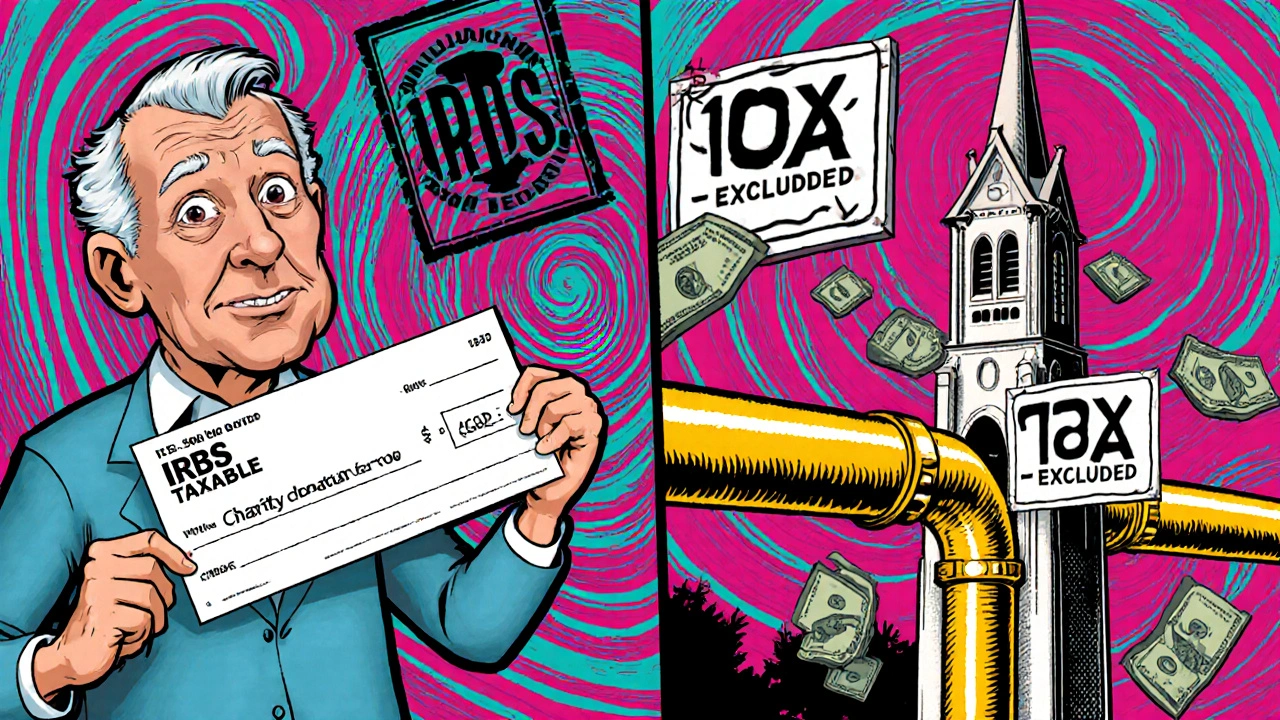
You can use a Roth IRA for a QCD - but only the taxable part. Roth IRAs are funded with after-tax money. So if you’ve had the account for five years and are over 59½, all withdrawals are tax-free. That means there’s nothing to exclude. A QCD from a Roth IRA would be pointless. But if you’re under 59½ or haven’t met the five-year holding period, earnings in your Roth are still taxable. That’s when a QCD makes sense. You can transfer those taxable earnings directly to a charity and avoid paying tax on them.How to Set Up a QCD
Step 1: Confirm your age. You must be 70½ or older by the date of the distribution. Step 2: Pick your charity. Make sure it’s a 501(c)(3). Avoid DAFs, private foundations, and supporting organizations. Step 3: Contact your IRA custodian. Most have a form or online tool for QCDs. Fidelity, Vanguard, and Schwab all have dedicated processes. Don’t just write a check from your IRA and mail it yourself. The transfer must be direct. Step 4: Get documentation. The charity should send you a thank-you letter that includes the date, amount, and confirmation it’s a QCD. Keep it with your tax records. Step 5: Time it right. The distribution must be processed by December 31 to count for that tax year. But processing takes time. If you wait until December 28, your check might not reach the charity until January. That means it counts for next year’s taxes. Plan ahead - give yourself at least two weeks.What Happens on Your Tax Return?
Your IRA custodian will send you a Form 1099-R showing the full distribution amount in Box 1. The taxable amount in Box 2a will be less - because you subtracted the QCD. Starting in 2025, custodians must mark QCDs with “Code Y” in Box 7. This is new. For 2025 distributions (reported in 2026), it’s optional. But you should still report the QCD yourself on Form 1040. Write the total distribution on Line 4a. Write the taxable amount (minus QCD) on Line 4b. Next to Line 4b, write “QCD” so the IRS knows why the amount is lower. Don’t claim a charitable deduction for the QCD amount. You can’t double-dip. The money is already tax-free.
Common Mistakes and Pitfalls
People mess up QCDs in predictable ways:- Trying to donate to a DAF. This is the #1 reason QCDs get rejected.
- Withdrawing cash and donating it later. That’s just a regular donation - no tax benefit.
- Forgetting to account for after-tax contributions. If your Traditional IRA has money you already paid tax on, the QCD is prorated. You can’t pick and choose which dollars to send. The IRS uses a formula to determine what portion is taxable.
- Not coordinating with RMDs. If you’re 73 and your RMD is $40,000, you can use a $40,000 QCD to satisfy it. But if you give $50,000, only $40,000 counts toward your RMD. The extra $10,000 is still tax-free - but it doesn’t reduce your RMD further.
- Donating after age 70½ but before 72. You can make a QCD at 70½, but you don’t have to take RMDs until 72 (or 73 if you turned 72 after Dec. 31, 2022). So you can give early - but it won’t reduce your RMD until you reach that age.
Who Benefits Most From QCDs?
QCDs aren’t for everyone. They’re perfect for:- Retirees who don’t need their RMDs for living expenses.
- People who give to charity regularly and want to give more than the 60% AGI limit allows.
- Those who don’t itemize deductions - which is most retirees now.
- People with high AGI who want to lower Medicare premiums or reduce Social Security taxation.
- People under 70½.
- Those who need their RMDs to pay bills.
- People who want to give to DAFs or private foundations.
- Anyone who wants to claim a tax deduction on top of the exclusion.
What’s Changing in 2025 and Beyond?
The biggest change is the new Code Y reporting. Custodians are required to flag QCDs on Form 1099-R. This helps the IRS track compliance. But it also means you need to be more careful. If your custodian doesn’t mark it right, you might get a letter from the IRS asking why you didn’t report the full amount as income. Also, the inflation adjustment means the limit will keep rising. If inflation stays high, $110,000 or even $115,000 could be possible by 2026. Experts like Ed Slott predict QCD usage will keep growing. As more people reach RMD age and fewer itemize deductions, QCDs will become the default way for retirees to give charitably. By 2030, nearly 80% of IRA owners over 70 are expected to use them.Final Thoughts
A QCD isn’t complicated. But it’s easy to mess up if you don’t know the rules. If you’re over 70½, have an IRA, and care about charity - this tool is built for you. It’s not a loophole. It’s a legal, IRS-approved way to give more, pay less in taxes, and simplify your finances. Start by checking your IRA balance. See how much you’re required to take out. See how much you want to give. Then call your custodian. Ask them how to set up a QCD. Most have a one-page form. You can do it in 10 minutes. Don’t wait until December. Give yourself time. And if you’re unsure, talk to a tax pro. But don’t skip it. This is one of the few tax strategies that helps you, your favorite charity, and your wallet - all at once.Can I use a QCD to satisfy my RMD?
Yes. If you’re 72 or older (or 73 if you turned 72 after December 31, 2022), a QCD can count toward your Required Minimum Distribution. For example, if your RMD is $35,000 and you make a $30,000 QCD, you’ve satisfied $30,000 of your RMD. You’ll still need to withdraw the remaining $5,000 - but you can take that as cash or another QCD. The QCD reduces your taxable income and fulfills your RMD requirement at the same time.
Can I make a QCD from a Roth IRA?
Yes, but only if there’s a taxable portion. Roth IRAs are funded with after-tax dollars. If you’re over 59½ and have held the account for five years, all withdrawals are tax-free - so a QCD from a Roth IRA wouldn’t provide any tax benefit. But if you’re under 59½ or haven’t met the five-year rule, earnings in your Roth are still taxable. You can transfer those taxable earnings via QCD to avoid paying tax on them.
Can I donate to a donor-advised fund (DAF) using a QCD?
No. Donor-advised funds (DAFs), private foundations, and supporting organizations are explicitly excluded from QCD eligibility by the IRS. Even if the DAF is run by a qualified charity, the IRS treats the DAF as an intermediary, not a direct recipient. If you send money to a DAF, it won’t count as a QCD. You’ll lose the tax exclusion and may not even get a deduction if you don’t itemize.
Do I need to itemize to use a QCD?
No. That’s one of the biggest advantages. Traditional charitable deductions require you to itemize your deductions on Schedule A. But with a QCD, the money is excluded from your income before you even file your return. You don’t need to itemize. Even if you take the standard deduction - which most retirees do - you still get the full tax benefit.
What if my IRA has both pre-tax and after-tax contributions?
The IRS uses a pro-rata rule. You can’t pick which dollars to give. If your IRA has $200,000 total, and $50,000 of that is after-tax money, then 25% of any distribution (including a QCD) is tax-free and 75% is taxable. So if you make a $10,000 QCD, $7,500 is treated as taxable and $2,500 as non-taxable. You can’t exclude the full $10,000. The taxable portion still counts as a QCD, but you’ll need to calculate it using IRS Publication 590-B. This can get complicated - consider working with a tax advisor if your IRA has mixed contributions.
Can I use a QCD to fund a charitable remainder trust (CRT)?
Yes - but only once, and under strict rules. Starting in 2025, you can make a one-time QCD to fund a charitable remainder unitrust (CRUT) or charitable remainder annuity trust (CRAT). The trust must be funded solely by that QCD. You can’t add more money later. The trust must be irrevocable, and the charity must be the sole beneficiary. This is a niche strategy, but it allows for structured, long-term giving while still getting the tax exclusion.
What happens if I miss the December 31 deadline?
The distribution won’t count for that tax year. Even if the charity receives the check in January, if the IRA custodian processed it after December 31, it counts as a 2026 QCD. To be safe, initiate the transfer at least two weeks before year-end. Many custodians take 5-10 business days to process QCDs. If you wait until December 28, you risk missing the cutoff. Don’t assume your bank or charity will handle it - confirm with your IRA provider.




Comments
Let’s be real - this is the single most underutilized tax hack for retirees in America. The IRS literally built this loophole to keep seniors from getting crushed by RMDs while still letting them do good. And yet, half the people I know who are 72+ are still writing checks to DAFs like it’s 2015. The fact that you can now fund a CRUT once with a QCD? Genius. That’s not just tax efficiency - that’s legacy engineering. If you’re not using this, you’re leaving money on the table for your favorite charity AND the IRS.
QCDs are the only reason I still talk to my CPA. I used to think charitable giving = itemizing. Then I hit 71, realized I’d never itemize again after TCJA, and found out I could dodge 22% federal + 5% state tax on $100K just by telling my broker to wire it to the food bank. No receipts. No Schedule A. Just ‘QCD’ scribbled on Line 4b. Best financial decision I made since selling my Tesla. Also - don’t even think about using Roth for this unless you’re under 59.5 and still have taxable earnings. Otherwise, you’re just moving money around like a confused squirrel.
It is truly remarkable how the legal architecture of tax policy can simultaneously serve both individual prudence and collective compassion - a rare alignment of self-interest and moral duty. One must pause and reflect upon the elegance of a system that permits an elderly individual, burdened by mandatory distributions, to redirect funds directly toward societal good without the bureaucratic interference of taxation. The exclusion, not deduction, mechanism is philosophically superior - it does not ask the taxpayer to justify their generosity, but rather acknowledges it as an inherent virtue. And yet, how many are still trapped in the outdated paradigm of writing checks? The pro-rata rule for mixed IRAs, though complex, is merely an invitation to deeper financial literacy - not a deterrent. One must not confuse administrative nuance with impossibility. The spirit of QCDs is not merely fiscal; it is ethical. And in an age where trust in institutions wanes, this quiet, lawful act of giving restores a fragile sense of civic dignity.
Thanks for this. I’ve been thinking about this for months but was scared to mess up. Just called my broker - they had a one-page form. Done in 8 mins. 😊
Wow. A whole 10,000-word essay on how to not pay taxes by giving money to churches. Groundbreaking. Next up: ‘How to Use Your 401(k) to Buy a Yacht and Call It a Charitable Remainder Trust.’ Look, I get it - you’re a retiree who doesn’t want to pay the IRS. Fine. But calling this ‘smart’? It’s just tax avoidance dressed up in virtue signaling. And don’t get me started on people who think ‘QCD’ is a magic spell. You’re not a philanthropist. You’re a guy who realized the IRS gave you a loophole and you’re exploiting it like a Wall Street hedge fund. Congrats. You’re the reason people hate finance.