
Robo-Advisor Crash Savings Calculator
How Much Could You Save?
Calculate your potential savings during market crashes based on 2020 data where robo-advisors lost 12.67% less than human-managed portfolios.
When the market crashed in March 2020, something surprising happened. While most human investors froze, panicked, or did nothing, robo-advisors quietly sold off risky assets and moved money into safer investments. The result? Investors using robo-advisors lost 12.67% less than those managing their own portfolios. That’s not luck. It’s code working exactly as designed.
How Robo-Advisors Actually Work
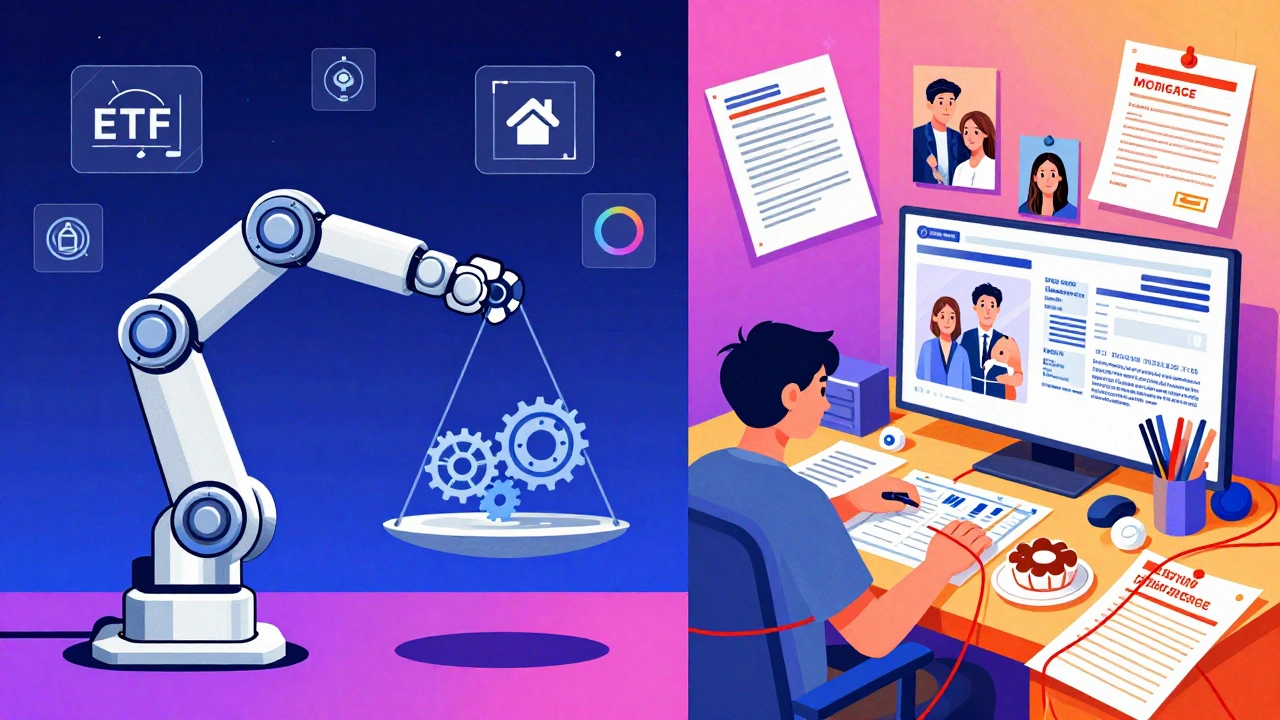
Robo-advisors aren’t magic. They’re software that follows strict rules based on modern portfolio theory. You answer a few questions-risk tolerance, time horizon, goals-and the system builds you a diversified portfolio of low-cost ETFs. Then it sits there, 24/7, making tiny adjustments without emotion.Here’s what it does automatically:
- Rebalances your portfolio every time it drifts off target
- Harvests tax losses daily to reduce your bill
- Adjusts asset allocation based on your age and goals
- Stays calm when markets panic
Platforms like Betterment and Wealthfront charge between 0.25% and 0.50% per year. On a $50,000 account, that’s $125 to $250 annually. No hourly fees. No pressure to buy something new. Just clean, automated management.
Where Human Advisors Still Win
But here’s the catch: robo-advisors don’t know your sister’s medical bills, your aging parents’ care needs, or whether you’re planning to quit your job and start a bakery next year. That’s where human advisors step in.A human advisor doesn’t just pick stocks. They help you navigate life’s big, messy moments:
- Should you sell your house to pay for your child’s college?
- How do you structure your estate so your kids don’t get taxed to death?
- Can you afford to retire early if your business takes a hit?
These aren’t algorithm-friendly questions. They require context, empathy, and judgment. Vanguard’s 2022 research found that 67% of robo-advisor users ended up needing a human advisor within 18 months for exactly these kinds of decisions.
Performance During Crisis: The Data Doesn’t Lie
The Carlson School of Management study from late 2023 looked at real investor behavior during the 2020 crash. They matched robo-advisor users with non-users who had similar incomes, ages, and portfolio sizes.Here’s what they found:
| Time Frame | Robo-Advisor Users | Human Investors |
|---|---|---|
| 1 Month | -0.86% | -1.22% |
| 3 Months | -2.55% | -3.60% |
That 1.05% difference over three months isn’t just a number. On a $100,000 portfolio, it means $1,050 more in your pocket. And that’s just during one crash. Over a full market cycle, those small edges add up.
Who Gets the Most Out of a Robo-Advisor?
Not everyone benefits equally. The data shows clear patterns:- Millennials (25-40): 48% use robo-advisors as their main tool. They want low cost, simplicity, and automation. They’re not managing multi-generational estates.
- Gen X (41-58): Only 22% rely on robo-advisors. Many use them for retirement accounts but turn to humans for real estate or business planning.
- Baby Boomers (59-77): Just 9% use robo-advisors. They value face-to-face trust and complex planning-things bots can’t replicate.
Reddit users summed it up: “I’m 28 and just want my 401(k) to grow. I don’t need a person telling me to ‘think long-term.’ The app does it for me.” Meanwhile, another user wrote: “I tried Betterment. It couldn’t tell me if I should take my pension as a lump sum or monthly payments. I had to call a human anyway.”

The Rise of the Hybrid Model
The future isn’t robo-vs-human. It’s robo-and-human.Vanguard now offers “Advisor Access” for robo-clients: $20 per video call with a real advisor. Schwab and Fidelity have similar features. Banks are rolling out hybrid services because they know one thing: people want automation for routine tasks, but still need a human for big life moments.
Financial Planning Association research from August 2024 found that advisors who use robo-tools to manage portfolios-while focusing their time on counseling-see higher client satisfaction and retention. It’s not about replacing humans. It’s about letting them do what humans do best.
What You Should Do in 2025
If your finances are simple-regular paycheck, no debt, clear retirement goal-go with a robo-advisor. Betterment, Wealthfront, or Fidelity Go will handle your investments for pennies. You’ll save thousands over time.If your life is complicated-multiple income streams, rental properties, aging parents, business ownership, or estate planning-start with a human advisor. But ask them: “Can you use automated tools to manage my portfolio?” Most can. You’ll get the best of both worlds: smart algorithms for routine tasks, and a real person for the messy stuff.
And if you’re unsure? Try a robo-advisor with a low minimum. Betterment lets you start with $0. Test it for six months. See how it feels. Then, if something feels off-like you’re stuck on a question they can’t answer-call a human. You don’t have to choose one or the other. The market has moved past that.
The real question isn’t whether robo-advisors beat human advisors. It’s whether you’re asking the right kind of questions. If you’re asking about asset allocation and tax efficiency, the bot wins. If you’re asking about legacy, fear, or family-then you need a person. The best investors know when to use each.
Do robo-advisors really make more money than human advisors?
Not always-but they often lose less during market crashes. During the 2020 pandemic downturn, robo-advisor users lost 12.67% less than human investors, according to a 2023 study from the Carlson School of Management. Their algorithms automatically reduced risk, while many humans held onto losing positions. Over time, that difference adds up. But in calm markets, returns are usually similar. The real advantage isn’t higher returns-it’s lower losses when things go wrong.
Are robo-advisors safe and secure?
Yes, they’re as safe as traditional brokerage accounts. Top robo-advisors like Betterment and Wealthfront are SEC-registered, use bank-level encryption, and partner with established custodians like Charles Schwab or Fidelity. Your assets are held in your name, not the robo-advisor’s. They’re also protected by SIPC insurance up to $500,000. The biggest risk isn’t hacking-it’s relying on a bot for advice you don’t understand.
Can I use a robo-advisor if I have debt or a side business?
Most robo-advisors can’t handle complex situations like debt payoff strategies or business cash flow planning. They’ll ask you to input your income and goals, but they can’t adjust for a fluctuating side hustle or a high-interest credit card. If you have these issues, use a robo-advisor only for your investment accounts, and talk to a human advisor about the rest. Many hybrid services now let you do exactly that.
What’s the cheapest robo-advisor right now?
Fidelity Go charges 0.35% on balances under $50,000 and has no minimum investment. Betterment and Wealthfront also charge 0.25% with $0 minimums. For basic investing, these are the most affordable options. But if you have more than $100,000, consider Vanguard Personal Advisor Services-they drop their fee to 0.30% and include human access.
Do I need to know anything about investing to use a robo-advisor?
No-you don’t need to know anything. But you’ll get better results if you do. Financial Planning Association research in 2024 found that users who understood basic concepts like diversification and fees achieved 18% better long-term outcomes than those who just clicked through the onboarding. You don’t have to be an expert, but reading a few articles on asset allocation will help you ask better questions and spot red flags.
Will robo-advisors replace human advisors completely?
No. Industry forecasts from Cerulli Associates predict that by 2027, only 28% of advisory relationships will be fully automated. Hybrid models-where bots handle investments and humans handle life decisions-will make up 47%. Traditional human-only advice will still be 25%. The future isn’t replacement. It’s collaboration. Robots manage money. Humans manage life.

Comments
It’s not about beating humans-it’s about recognizing where each excels. Algorithms don’t feel fear, so they don’t freeze. But neither do they feel grief when your parent gets sick, or joy when your kid gets into college. The market moves on numbers; life moves on meaning. And if you let a bot decide when to cash out your inheritance to pay for your daughter’s surgery… well, you’ve outsourced your humanity. I’m not anti-tech. I’m pro-soul.
lol u guys really think these robo-advisors are just ‘neutral code’? pffft. they’re built by hedge funds who know exactly when to dump assets before a crash-then buy back cheap after the panic. the 12.67% ‘edge’? that’s not luck, that’s front-running you. they’re not protecting you-they’re exploiting your fear. and dont get me started on how they track your clicks to sell your data to ad brokers. its all a psyop. the real ‘hybrid’ model? you’re the product. 🤔
JUST START WITH BETTERMENT FOR $0. 🚀 no cap. i did it. 6 months later i was like ‘wait… i didn’t do ANYTHING and my portfolio grew?’ 😭💸 now i use it for my 401k and call a human when my biz cashflow gets weird. bot for boring stuff. human for drama. that’s the win. 🙌